
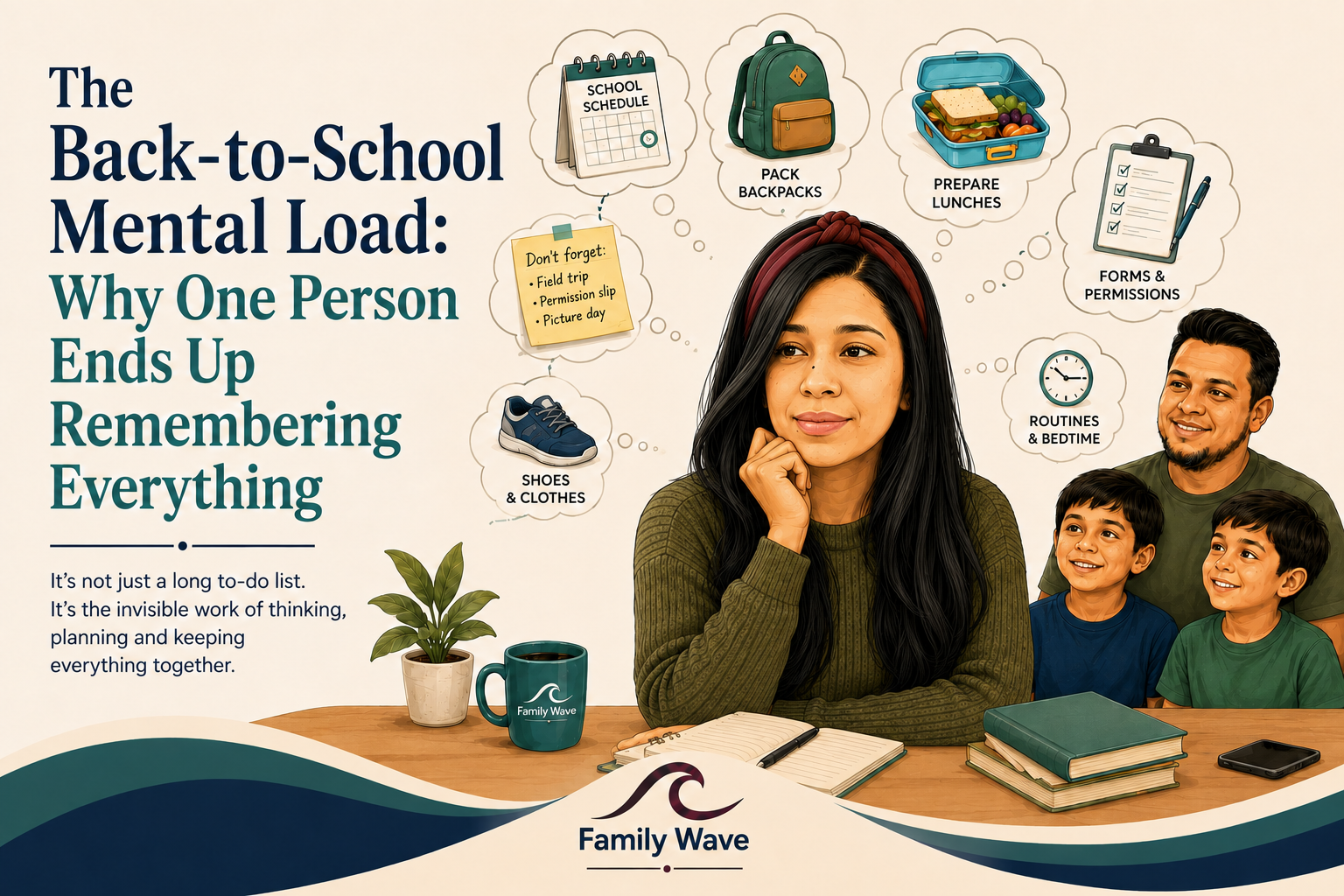
Back-to-school season looks, at first, like one long to-do list.
Buy the school supplies. Check the shoes. Prepare the backpacks. Organize lunches. Complete the forms.
But that is only the visible part.
Underneath it is another, much longer list that is rarely written down.
Someone has to remember when school starts. Check which clothes still fit. Find the supply list. Read the school emails. Review schedules. Think about lunches. Remember extracurricular activities. Complete permission forms. Reset bedtime routines. Figure out what still needs to be purchased.
And then remember which of those things still haven't been done.
That invisible work is part of the family mental load.
Back-to-school has a way of making it especially noticeable because so many decisions, deadlines and small details arrive at the same time.
The problem is not always that there is simply too much to do.
Often, the real problem is that one person feels responsible for remembering all of it.
What Is the Back-to-School Mental Load?
Mental load is not simply doing tasks.
It is the work of thinking about the tasks.
Buying school shoes, for example, sounds simple.
But before anyone buys them, someone usually has to notice that last year's pair no longer fits, check the size, see whether the school has specific requirements, find time to shop, take the child to try them on and make sure the shoes are ready before school begins.
The visible task was:
Buy school shoes.
But several decisions happened before that task was completed.
The same thing happens throughout family life.
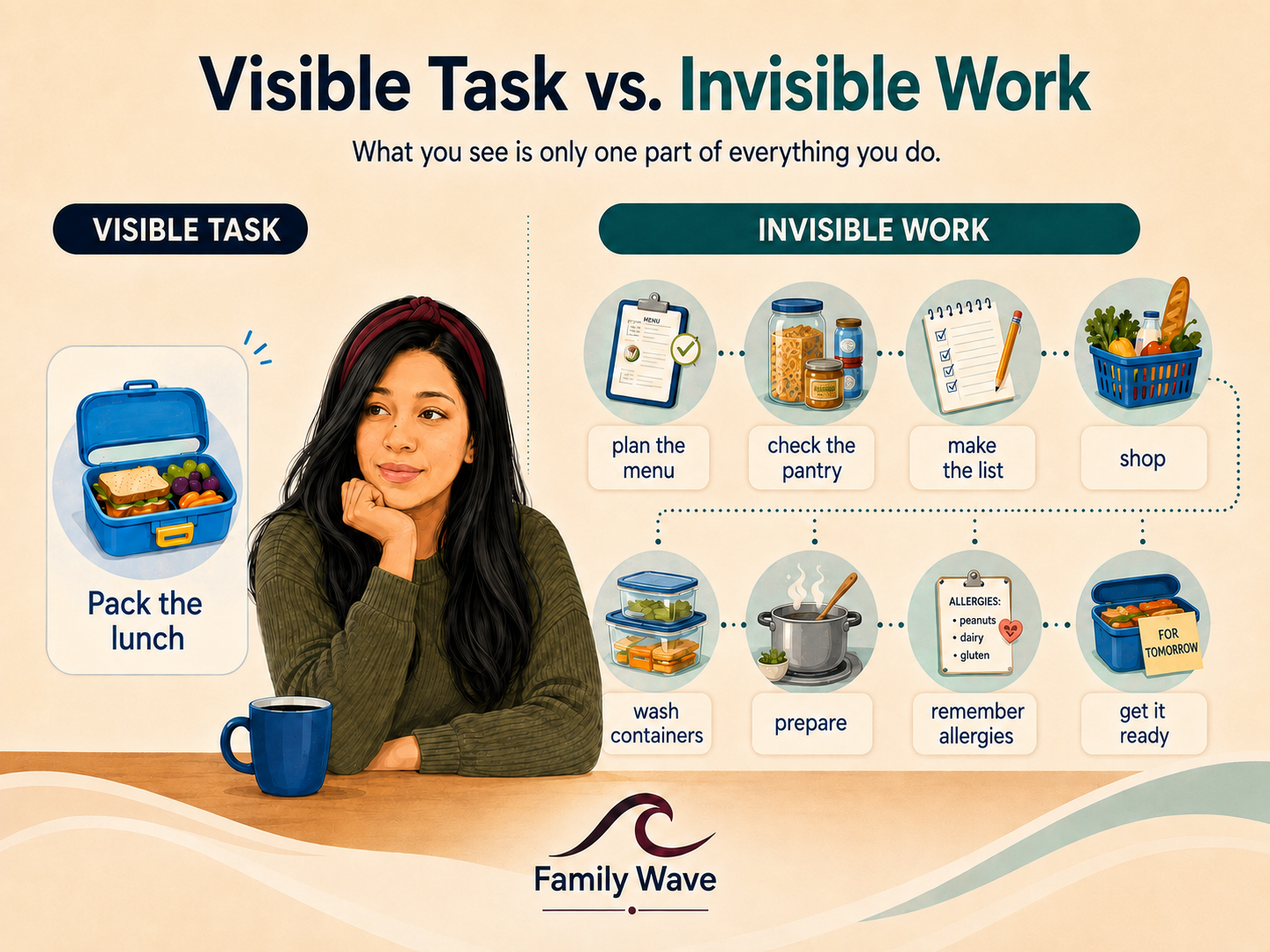
Preparing a school lunch does not start when you open the lunchbox in the morning.
It starts when someone decides what the child will eat, checks what is already at home, adds missing ingredients to the grocery list, shops for them, prepares food in advance and remembers that a lunch still has to be packed for tomorrow.
Researchers often describe this kind of work as cognitive household labor: the anticipating, planning, organizing and monitoring required to keep a household functioning.
It may be less visible than physical chores, but it still takes time, attention and mental energy.
The Invisible Work Behind the First Day of School
Think about everything a family may be coordinating around the beginning of the school year.
School
Emails, forms, permissions, schedules, important dates and teacher information.
Clothes
Checking sizes, deciding what can be reused, shoes, sports clothes and preparing for the change of season.
Backpacks and Supplies
School lists, labels, water bottles, lunchboxes, folders and supplies.
Food
Breakfasts, lunches, snacks, groceries and advance preparation.
Routines
Bedtime, wake-up time, getting ready the night before and leaving the house.
Activities
Registrations, schedules, uniforms, equipment, transportation and payments.
Homework
Knowing what needs to be completed, when it is due and what materials are required.
Each item looks relatively small on its own.
The weight appears when one person has to keep all of those pieces connected in their head.
And many times that person is not only remembering their own responsibilities.
They are remembering everyone else's too.
How Does One Person Become the Family's Memory?
Most families never consciously decide that one person should remember everything.
It happens gradually.
One person completes the school registration and starts receiving the emails.
Because they know the school schedule, they also remember the activities.
Because they know what the children eat, they organize the lunches.
Because they already know what is missing, they make the shopping list.
And because that person seems to know everything, everyone starts asking them.
“What time is swimming?”
“Do they need their uniform tomorrow?”
“Where is the form?”
“What do they have to bring on Friday?”
“Did we buy the shoes?”
Over time, that person stops being simply another member of the family.
They become the family information system.
The exact division of responsibilities looks different in every household, and mental load is not exclusively a mother's issue.
The more useful question is:
If one person stopped remembering everything for a week, how many things would stop happening?
The answer can reveal a lot about how the family is organized.
“Help Me” Does Not Always Mean the Responsibility Is Shared
There is an important difference between helping with a task and owning a responsibility.
Imagine one parent says:
“Can you prepare the children's backpacks tonight?”
The other person prepares them.
The task was shared.
But who remembered that the backpacks needed to be prepared?
Who knew what needed to go inside?
Who noticed that a form had to be signed?
Who will check afterward that nothing was forgotten?
If one person still has to notice, assign, remember and supervise the task, a large part of the mental load is still sitting in the same place.
Sharing responsibility does not only mean:
“Do this thing I remembered needed to be done.”
It also means transferring some responsibility for noticing that it needs to happen in the first place.
Instead of:
“Tell me how I can help.”
A better question becomes:
“What can I take responsibility for?”
How to Get the School Year Out of One Person's Head
You do not need a perfect family organization system before the first day of school.
Start much smaller.
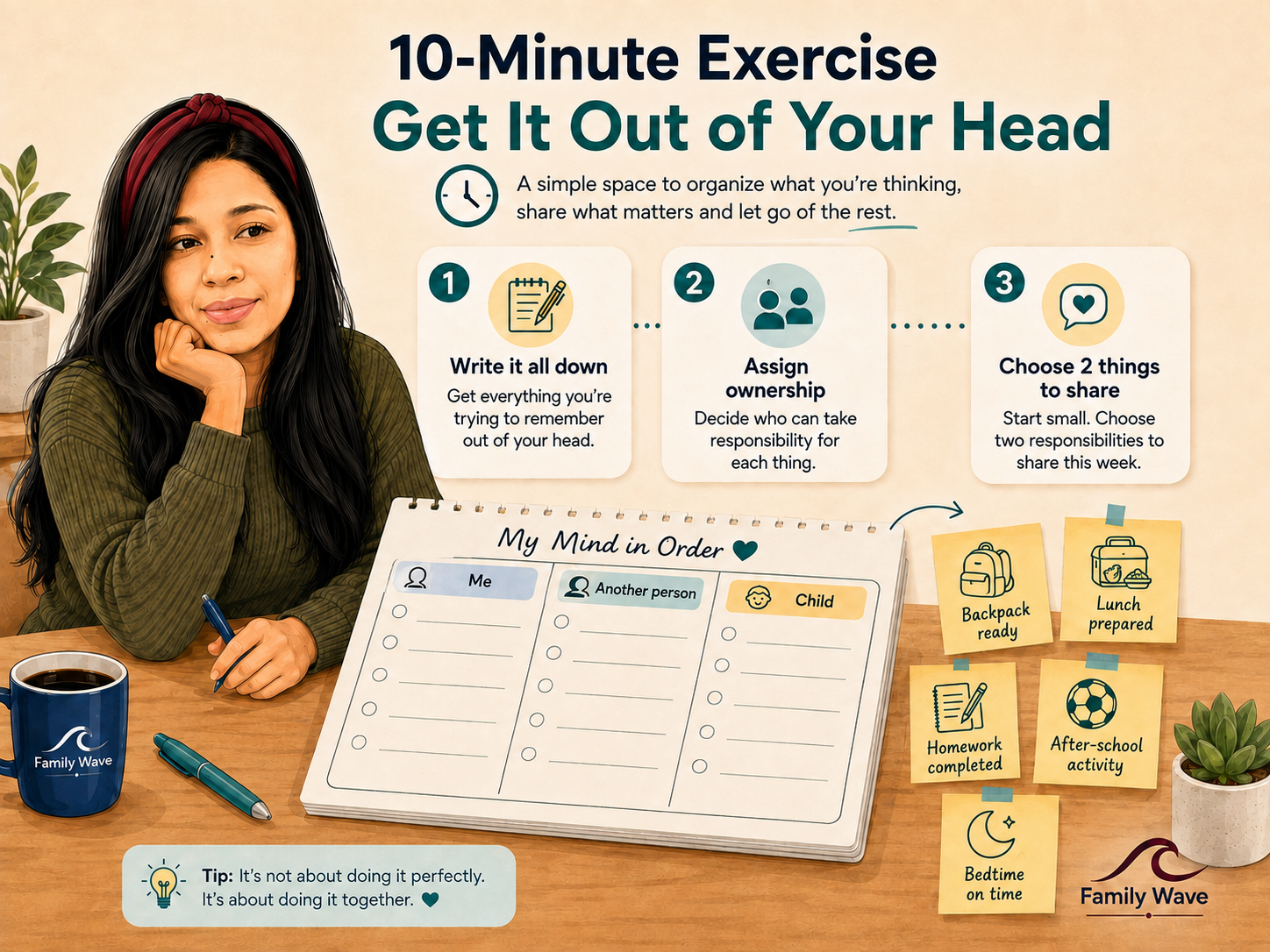
1. Write Down Everything You're Trying to Remember
Do not organize it yet.
Take ten minutes and write.
Backpacks.
Lunches.
Uniforms.
Thursday's activity.
The form that still needs to be signed.
Shoes.
Bedtime.
Library books.
Appointments.
Soccer payments.
Everything.
The purpose is not to create another overwhelming list.
It is to make visible what was previously taking up space in someone's head.
2. Ask Who Actually Owns Each Responsibility
Put a name beside each area.
Not the person who can “help.”
The person who will be responsible for making sure that area works.
If one adult owns swimming, for example, they can be responsible for knowing the schedule, preparing the necessary equipment and keeping track of changes related to that activity.
Responsibility is not truly shared if someone else still has to manage it from behind the scenes.
3. Let Children Own Age-Appropriate Responsibilities
Children should not be responsible for adult logistics.
But they can gradually participate in the systems that support their own routines.
Depending on age, that might include:
- putting their backpack in the same place every day;
- bringing their water bottle to the kitchen;
- placing school papers in a designated spot;
- preparing simple items for the following day;
- following a short morning routine.
The goal is not to make children responsible for running the household.
It is to teach them that family life works better when everyone participates.
4. Make Information Visible
The more information that exists only inside one person's head, the more everyone depends on that person.
A shared calendar.
A checklist.
A designated place for school papers.
A shared shopping list.
A visible routine.
Any system that allows someone to find the answer without asking:
“What are we doing tomorrow?”
reduces a small piece of the mental load.
5. Review the Week Once Instead of Twenty Times
Family organization does not need to become an all-day conversation.
A short weekly review can be enough.
Take ten minutes to check:
- upcoming school events;
- activities;
- transportation changes;
- things that need to be purchased;
- documents that need attention;
- unusual schedule changes;
- who owns what.
Ten minutes of anticipation can prevent many last-minute conversations later.
Try This Today: The 10-Minute Exercise
Before buying another organizer or creating a complicated family system, try something simpler.
Set a timer for 10 minutes.
Write down everything related to back-to-school that you are currently trying to remember.
Then look at the list and ask:
Does this depend on me?
Does someone else fully own this responsibility?
Could one of the children participate in this?
Do not try to redistribute the entire family operation today.
Choose only two responsibilities that could stop depending entirely on one person this week.
That is enough to begin.
The Goal Is Not to Remember Everything Better
It is easy to assume the solution to mental load is becoming even more organized.
A better planner.
More alarms.
More lists.
More effort.
But if one person still has to create every list, program every reminder, update every calendar and remind everyone else to check it, the underlying problem has not changed.
The goal should not be to create one person who is capable of remembering everything.
The goal is to build a family system that does not require one person to remember everything.
That means making information visible.
Sharing real ownership.
Creating simple routines.
Giving children appropriate opportunities to participate.
And creating a common place where the family can understand what is happening.
That is also the idea behind Family Wave.
Family organization should not depend on the memory of one person.
Your family has a lot to remember. You don't have to remember it all.